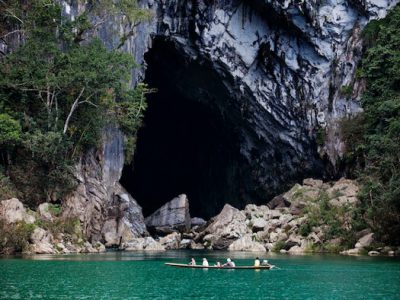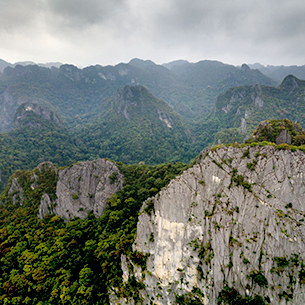
Laos has a new World Heritage treasure as Hin Nam No National Park in Khammouane Province was officially inscribed as a UNESCO World Heritage Site on 13 July.
This designation also establishes Hin Nam No as a Transboundary World Heritage Site, formally linking it with Vietnam’s Phong Nha-Ke Bang National Park. Together, they form the world’s largest contiguous limestone karst landscape, an ecosystem shaped by more than 300 million years of geological evolution.
Spanning over 94,000 hectares in the country’s southeast, Hin Nam No is one of the most ecologically and culturally significant protected areas in the Central Annamite Mountains. The park’s rugged terrain features towering limestone cliffs, pristine forests, remote valleys, and nearly 200 documented caves. Among them is Xe Bang Fai, considered the world’s largest functioning underground river.
The name “Hin Nam No,” meaning “mountain crest, spiky as bamboo shoots,” reflects the dramatic, serrated peaks that define the landscape. It is located within the Indo-Burma biodiversity hotspot and provides critical habitat for more than 1,500 plant species and hundreds of vertebrate animals. Endangered species like the red-shanked douc langur, Sunda pangolin, Lao rock rat, and giant huntsman spider find sanctuary in this protected environment.
Hin Nam No is also home to several ethnic minority communities, each preserving unique customs, languages, and traditions passed down through generations.
With this inscription, Hin Nam No becomes Laos’ fourth UNESCO World Heritage Site, joining Luang Prabang, Vat Phou, and the Megalithic Jar Sites of Xiengkhuang.
For more information, get in touch with our reservation team in Laos at: [email protected]